

Are you wondering how to pass WAEC Biology this year? You are not alone. Biology is one of the most important science subjects in the WAEC examination, and it is required for admission into courses like Medicine, Nursing, Pharmacy, Biochemistry, Microbiology, and Agriculture.
The good news? WAEC Biology is very passable if you prepare the right way. After analyzing 24 years of WAEC Biology past questions (from 2000 to 2023), I’ve identified patterns, repeated topics, and the exact strategies students who score A1 use.
In this guide, I will share 15 proven tips that will help you pass WAEC Biology — not just pass, but score an A1 or B2.
Understanding the WAEC Biology Exam Structure
Before we dive into the tips, let’s understand what you are preparing for:
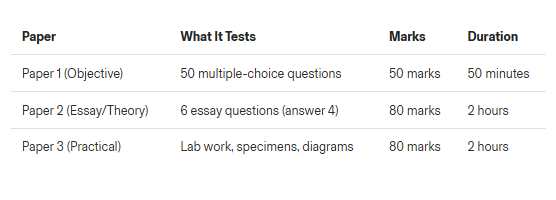
Total: 210 marks. To get an A1, you typically need 75% and above (approximately 158+ marks). A credit pass (C6) requires about 50% (105 marks).
Now let’s get into the tips.
Tip 1: Start With the WAEC Biology Syllabus
Every question WAEC sets comes directly from the syllabus. If you study random topics without checking the syllabus, you are wasting time.
Download the official WAEC Biology syllabus from the WAEC website and tick off each topic as you study it. The syllabus is divided into five sections:
- Organization of Life (cell biology, classification)
- Organisms and Their Environment (ecology, habitats)
- Continuity of Life (genetics, reproduction, evolution)
- Organisms at Work (nutrition, transport, respiration)
- Biology and Human Welfare (diseases, conservation)
Action step: Print the syllabus and hang it on your wall. Tick topics as you complete them.
Tip 2: Focus on the Most Repeated WAEC Biology Topics
After studying 24 years of past questions, these are the 15 topics WAEC asks every single year:
- ✅ Cell Structure and Functions
- ✅ Photosynthesis and Respiration
- ✅ Genetics and Heredity (Mendel’s Laws)
- ✅ Ecology (Food chains, food webs, nutrient cycling)
- ✅ Reproduction in Plants and Animals
- ✅ Excretion and the Kidney
- ✅ Transport System (Heart, blood circulation)
- ✅ Nutrition and Digestive System
- ✅ Evolution and Adaptation
- ✅ Classification of Organisms
- ✅ Support and Movement (Skeleton, muscles)
- ✅ Osmosis, Diffusion, and Active Transport
- ✅ Sense Organs (Eye, Ear)
- ✅ Plant Hormones and Tropisms
- ✅ Pollution and Conservation
If you master these 15 topics thoroughly, you can comfortably score B3 or higher in WAEC Biology.
Tip 3: Practice Past Questions (The Right Way)
This is the number one secret of students who score A1. WAEC repeats question patterns — sometimes the exact same question appears again with minor changes.
Here is the right way to use past questions:
- Don’t just read the questions and answers. Actually attempt them under timed conditions.
- Start from the most recent year and work backward (2023 → 2022 → 2021…).
- After attempting, check your answers and note every topic you got wrong.
- Go back and study the topics where you scored poorly.
- Attempt the same paper again after one week to see improvement.
Aim to complete at least 10 years of past questions before the exam.
💡 At NaijaBiologyTips, we have explained every WAEC Biology past question from 2000 to 2023 in clear video lessons. Instead of reading text answers, you can watch step-by-step video explanations. Start watching free lessons here →
Tip 4: Master Biological Diagrams
WAEC awards up to 15 marks for well-drawn and properly labeled diagrams. Many students throw away easy marks because they cannot draw diagrams neatly.
Diagrams you MUST know how to draw:
- Animal cell and plant cell
- Human digestive system
- Human heart (longitudinal section)
- Human eye
- Human ear
- Kidney (nephron)
- Male and female reproductive systems
- T.S. of a dicot leaf
- T.S. of a monocot and dicot stem
- Stages of mitosis and meiosis
Tips for drawing diagrams:
- Use a sharp pencil (not pen)
- Draw large and clear (at least half a page)
- Label with straight, horizontal lines (not curved arrows)
- Write labels clearly beside each line
- Add a title below the diagram
Tip 5: Don’t Ignore the Practical Paper
Paper 3 (Practical) is worth 80 marks — that’s 38% of your total Biology score! Many students focus only on theory and neglect practicals.
How to prepare for Biology practical:
- Learn common specimens and their features (cockroach, tilapia, bean seed, maize grain, etc.)
- Practice food tests (Benedict’s test, Biuret test, iodine test, etc.)
- Know how to use a microscope and calculate magnification
- Practice drawing specimens from observation
- Study ecological tools (quadrat, sweep net, Secchi disc, etc.)
Tip 6: Create a Study Timetable
Studying without a plan is like traveling without a map. Create a timetable that:
- Covers all syllabus topics before the exam
- Allocates more time to your weak topics
- Includes past question practice at least 3 times per week
- Includes practical revision at least once per week
- Has rest days (you need sleep for memory retention!)
Tip 7: Use Video Lessons for Difficult Topics
Some topics are hard to understand from textbooks alone — especially genetics, ecology, and the circulatory system. Video lessons help because:
- You can see diagrams being drawn step by step
- You can pause and replay difficult parts
- Complex processes like mitosis and meiosis are easier to visualize
- You can study anytime, anywhere on your phone
📱 At NaijaBiologyTips, all our lessons are in video format with clear visual explanations. Explore our courses →
Tip 8: Understand, Don’t Memorize
WAEC Biology essay questions test understanding, not memorization. Examiners can tell when you cram definitions word-for-word without understanding.
Instead of memorizing: “Osmosis is the movement of water molecules from a region of lower solute concentration to a region of higher solute concentration through a semi-permeable membrane.”
Understand it like this: “Water naturally moves from where there’s more water to where there’s less water, through a special barrier that only lets small molecules pass.”
When you understand, you can explain in your own words — and that’s what WAEC rewards.
Tip 9: Learn Key Biological Terms
While you shouldn’t memorize entire definitions, you must know key terms accurately. WAEC objective questions often test your knowledge of specific terms:
| Term | Meaning |
|---|---|
| Photosynthesis | Process by which green plants make food using sunlight |
| Homeostasis | Maintenance of a stable internal environment |
| Peristalsis | Wave-like muscle contractions that move food through the gut |
| Phagocytosis | Process by which white blood cells engulf pathogens |
| Transpiration | Loss of water vapor from plant leaves through stomata |
| Geotropism | Growth response of plants to gravity |
Make flashcards of 50–100 key terms and review them daily.
Tip 10: Form or Join a Study Group
Explaining biology concepts to others helps you understand them better. In a study group:
- Each member can teach one topic per session
- You can quiz each other with past questions
- You’ll stay motivated and accountable
- Difficult topics become easier when discussed
Tip 11: Take Care of Your Health
Your brain needs fuel to perform well:
- Sleep 7–8 hours every night (memory consolidation happens during sleep)
- Eat balanced meals (especially brain foods like fish, eggs, and vegetables)
- Stay hydrated — drink enough water
- Exercise at least 30 minutes daily
- Avoid all-night cramming — it does more harm than good
Tip 12: Practice Time Management in the Exam Hall
Many students know the answers but fail because they run out of time. Practice this:
- Paper 1 (Objective): 50 questions in 50 minutes = 1 minute per question. Don’t spend 3 minutes on one question — move on and come back.
- Paper 2 (Essay): 4 questions in 2 hours = 30 minutes per question. Spend 5 minutes planning and 25 minutes writing.
- Start with questions you know best to build confidence and secure marks.
Tip 13: Read the WAEC Examiner’s Report
WAEC publishes an Examiner’s Report every year that reveals:
- Common mistakes students make
- Topics where students performed poorly
- How students lose marks unnecessarily
This is like getting insider information from the people who set and mark your exam!
Tip 14: Review Your Weak Areas Weekly
Every week, look at your past question scores and identify:
- Which topics do I keep getting wrong?
- Which question types confuse me?
- Am I making careless mistakes?
Then focus your next week’s study on those weak areas. This is how A1 students study — they fix weaknesses instead of repeating what they already know.
Tip 15: Stay Confident and Positive
Believe that you CAN pass WAEC Biology. Many students defeat themselves before they even enter the exam hall by thinking:
- “Biology is too hard”
- “I can never understand genetics”
- “I always fail science subjects”
Replace these with:
- “I am preparing well and I will score A1”
- “Every topic I study brings me closer to success”
- “Other students have passed, and so will I”
Your WAEC Biology Action Plan
| When | What To Do |
|---|---|
| 6 months before | Start reading the syllabus topic by topic |
| 3 months before | Begin past question practice (2-3 papers/week) |
| 1 month before | Intensive revision of weak topics + diagrams |
| 1 week before | Light revision, review notes, rest well |
| Exam day | Stay calm, read questions carefully, manage time |
Final Words
Learning how to pass WAEC Biology is not about luck or “expo” — it’s about consistent preparation, smart strategies, and believing in yourself.
With 24 years of past questions explained in video format, structured courses aligned with the WAEC syllabus, and a community of dedicated students, NaijaBiologyTips gives you everything you need to score A1.
👉 Start your free lesson today at NaijaBiologyTips.site
Did you find this helpful? Share it with a friend who is also writing WAEC Biology!
Have questions? Send us a message on WhatsApp: [08142105609]